Back to Blog
Breach Analysis
July 24, 2026
Rohan Takke
7 min read
Bank of Baroda Data Breach: What You Need to Know
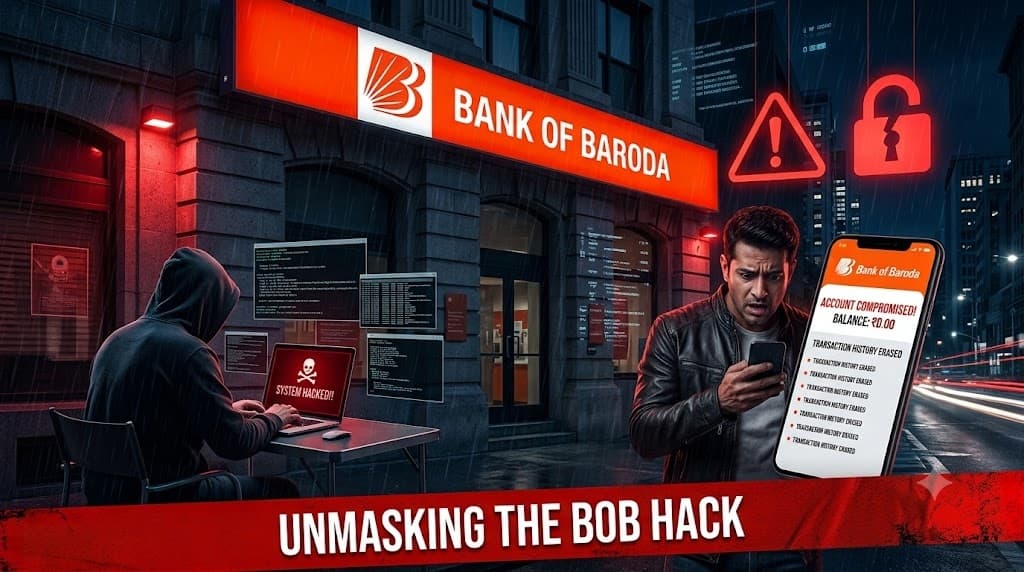
This post breaks down the timeline, and lessons learned from one of India's largest banking breaches, highlighting security failures and the importance of MFA, Zero Trust, DLP, and SIEM/UEBA for protecting sensitive data.
Generated by Gemini
What Actually Happened
On July 27, 2026, Bank of Baroda admitted to experiencing a cybersecurity attack. An attacker stole 1 terabyte of sensitive customer and internal data, making it one of India's largest banking breaches.
What was exposed:
- 100,000–300,000 account-opening forms with customer KYC documents, Aadhaar numbers, PAN details, and photos
- Customer banking records, loan files, and corporate data
- Internal emails and branch audit reports
The silver lining: Bank of Baroda said its core banking systems were not accessed or affected—meaning customer accounts themselves weren't compromised.
Timeline: July 24 — TripleX lists data on ransomware.live; July 25 — Cybersecurity researchers flag it publicly; July 27 — Bank confirms the breach.
How It Happened
This wasn't a sophisticated cyberattack. It required one employee to have a password that was not strong enough, reused from another platform, or obtainable through phishing.
The attack path:
- Attacker compromised a single employee's email account
- Likely methods: phishing, credential reuse from previous breaches, or weak password brute-forcing
- Once inside, no network segmentation prevented access to sensitive data
- Attacker silently downloaded 1TB over 2.5 months
Why it went undetected:
- No encryption = no antivirus alerts
- No data loss prevention (DLP) tools detected the massive download
- The average time between initial access and lateral movement is just 29 minutes. TripleX had 2.5 months.
TripleX attributed initial access to weak passwords and security errors, and instead of demanding ransom, they released the data publicly to "punish" the bank.
The Complete Attack Timeline
May 12, 2026 — Initial Compromise
- Employee's email account breached through phishing or credential reuse
- Attacker gains access to internal repositories
May 12 - July 24 — Silent Data Theft (2.5 Months)
- Attacker silently explores the network with no segmentation barriers
- Discovers and maps sensitive customer and internal banking data
- Downloads approximately 1TB of files
- Zero alerts from monitoring systems
July 24-27 — Public Disclosure
- TripleX publishes data on dark web (ransomware.live)
- Cybersecurity researchers discover it through dark web monitoring
- Bank of Baroda doesn't detect it; external researchers do
- News spreads through social media; bank finally responds
Why detection took so long: The bank wasn't actively monitoring for data exfiltration. It relied on external researchers to discover the breach.
Prevention: How to Stop This Attack
This breach was entirely preventable. Every vulnerability exploited has known solutions.
1. Mandatory Multi-Factor Authentication (MFA)
Critical: Enforce MFA on every employee email account without exception. Every email login requires a second factor.
- Use phishing-resistant methods like hardware security keys (FIDO2/WebAuthn)
- Avoid SMS 2FA (vulnerable to SIM swapping)
- Mandatory for all admin and finance roles
This single control would have stopped the Bank of Baroda breach immediately.
2. Implement Zero Trust Architecture
The RBI's Financial Stability Report recommended a shift to Zero Trust Architecture—a framework in which no user or account is trusted by default and access rights are micro-segmented so that a single compromised credential cannot traverse an entire document repository.
Key actions:
- Never assume internal traffic is safe
- Require verification for every access request
- Implement least privilege: employees access only what they need for their role
- A compromised HR account cannot reach finance systems
- Continuously monitor and alert on suspicious patterns
3. Deploy Data Loss Prevention (DLP)
- Detect unusual data access patterns (100GB download when normal is 100MB)
- Alert on suspicious bulk downloads
- Block downloads of sensitive data to external locations
- Understand what constitutes sensitive data (Aadhaar, PAN, account numbers)
This would have caught the 1TB download immediately.
4. Monitor with SIEM/UEBA
Utilize SIEM/UEBA to continuously monitor user behavior, detect anomalous account activity, and generate real-time alerts for potential compromises.
Track:
- Login attempts from unusual locations
- Bulk data access during off-hours
- Email forwarding rule changes
- Excessive failed login attempts
5. Email Authentication and Security
- Implement SPF, DKIM, and DMARC to prevent spoofing
- Deploy advanced email filtering for phishing detection
- Monitor for suspicious email forwarding rules
- Block legacy authentication protocols
6. Encrypt Sensitive Data
Apply data classification, encryption, and strict access controls to sensitive information such as KYC records, Aadhaar numbers, PAN details, and banking documents.
- Encrypt data at rest and in transit
- Manage encryption keys securely
- Different access levels based on data sensitivity
7. Regular Employee Training
- Run phishing simulations quarterly
- Teach password hygiene (never reuse across platforms)
- Train on recognizing credential phishing
- Create a culture where employees report suspicious emails immediately
8. Incident Response Readiness
- Create playbooks for email compromise scenarios
- Practice rapid account containment (password reset, token revocation)
- Maintain tested data backup procedures
- Have incident response drills quarterly
What This Means for Customers
The exposed data creates three main risks:
-
Social Engineering Fraud: The primary threat is not direct account compromise but social engineering fraud, where criminals use leaked personal details to manufacture trust before extracting OTPs or passwords.
-
Identity Theft: Complete KYC documents with photos enable fraudulent loan applications and accounts opened in victims' names.
-
SIM Swap Attacks: With Aadhaar and phone numbers, attackers can impersonate customers to telecom companies.
Immediate steps:
- Change internet and mobile banking passwords
- Enable MFA on banking accounts
- Monitor bank statements and credit reports
- Report any suspicious activity to your bank or call India's cybercrime helpline (1930)
Key Lesson
One weak password. One unmonitored email account. No network segmentation. No data loss alerts. This is how one of India's largest banks lost 1TB of customer data.
The attack required zero sophisticated exploits, zero zero-day vulnerabilities, and zero technical wizardry. It required one thing: security basics that were missing.
The good news: All of these vulnerabilities are solvable with proper controls, monitoring, and architecture. The question is whether India's banking sector will finally implement them.
References & Sources
- CyberPeace Foundation - The Bank of Baroda Data Breach ~ What We Know, What We Don't, and What Comes Next
- Business Today - Bank of Baroda hit by cyberattack; 1TB of sensitive data allegedly leaked
- The Record (Recorded Future) - India's Bank of Baroda confirms cyber incident after hackers claim data theft
- Business Standard - BoB hit by cyberattack: 1 terabyte of customer data 'leaked on dark web'
- Cy5.io - Bank of Baroda Data Breach 2026: How It Happened & Lessons
- Threatsys - Bank of Baroda Data Leak: Inside the Alleged 1,000GB Breach Every Customer Should Know About
- TechTimes - Bank of Baroda Breach: TripleX Dumps 1 TB of Aadhaar and Account Data for Free
- TechObserver - Bank of Baroda Data Breach: TripleX Attack Lessons for Enterprises
- Gurucul - Bank of Baroda Data Leak: Analysis of the Triple X Extortion Claim and Exposed Customer Data
- The420.in - Bank of Baroda Confirms Data Breach After Employee Email Hack; 1TB Data Alleged on Dark Web
- Skeletos - One Email. One Weak Password. India's Biggest Banking Breach Of 2026 Started Here
- Adaptive Security - How to Prevent Business Email Compromise (BEC) Fraud
- RBI Financial Stability Report (June 2025) - Zero Trust Architecture Recommendations
- CrowdStrike 2026 Global Threat Report - Adversary Breakout Time Analysis
Disclaimer: This article is based on publicly available information as of August 2026. Bank of Baroda customers should follow official bank guidance and regulatory announcements.