Back to Blog
Breach Analysis
May 23, 2026
Rohan Takke
9 min read
Decoding the GitHub 2026 Breach: How a VS Code Extension Breached GitHub
A deep dive into how a poisoned VS Code extension and an internal RCE vulnerability exposed GitHub’s internal systems and reshaped how we think about developer supply chain security.
May 2026 — The breach that wasn't supposed to happen, happened.
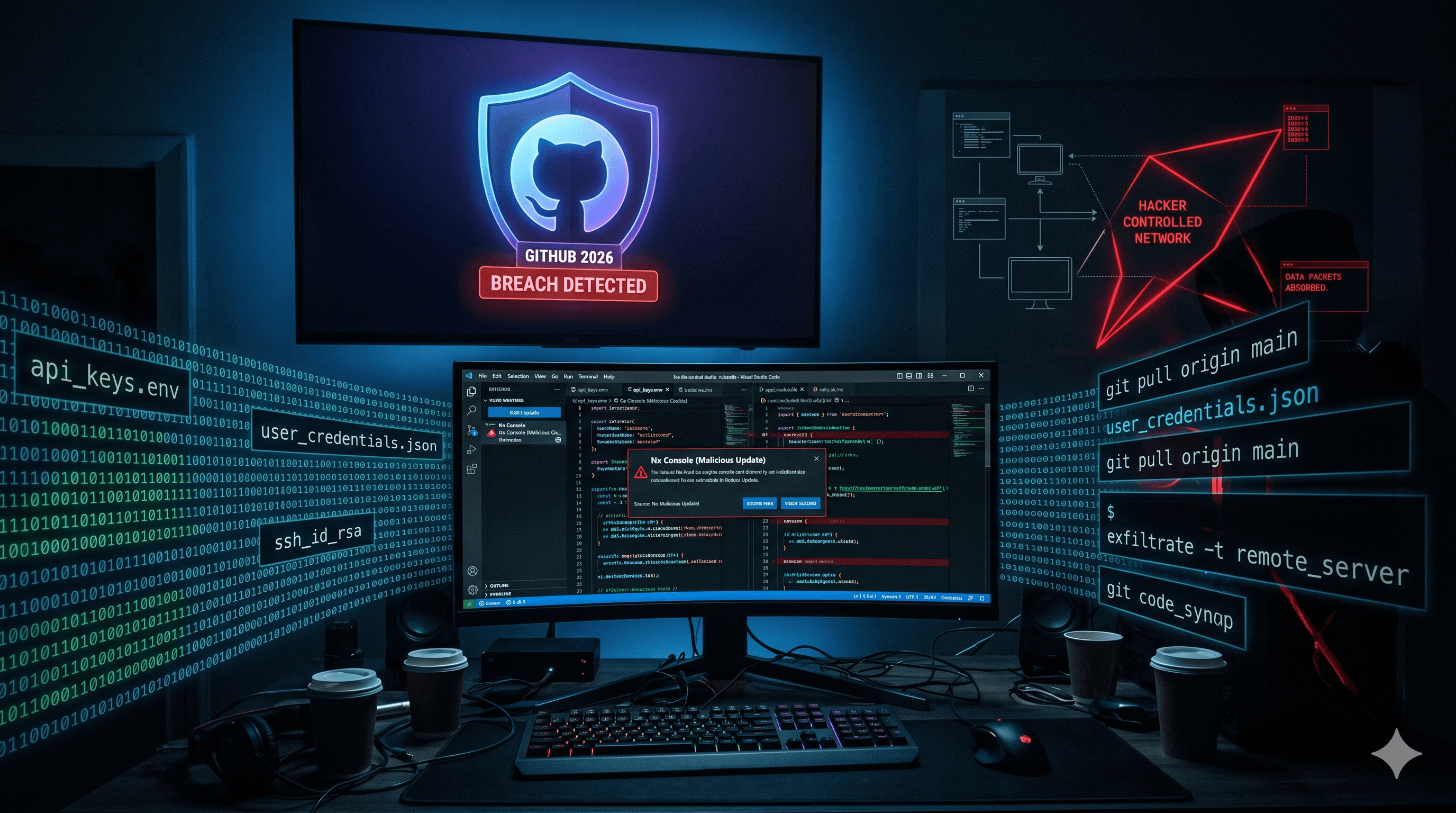
Generated by Gemini
The Headlines Don’t Tell the Full Story
When news broke on May 20, 2026 that GitHub had been compromised, the developer community reaction was disbelief.
GitHub isn’t just another tech company, it is the backbone of the global software supply chain. So when reports confirmed an internal breach, most assumed a sophisticated zero-day in GitHub’s infrastructure.
That assumption was wrong.
The real story is far more uncomfortable: the attack didn’t begin in GitHub’s core systems. It began in a developer’s IDE.
What Actually Happened
Between May 19–20, 2026, GitHub confirmed a security incident affecting its internal corporate environment.
A threat actor known as TeamPCP (tracked by some intelligence firms as UNC6780) compromised a GitHub employee’s workstation.
Not through infrastructure exploits.
Not through stolen cloud credentials.
But through something far more mundane: a malicious VS Code extension.
The Entry Point: A Malicious Extension
The poisoned extension was Nx Console (published on the VS Code Marketplace under nrwl.angular-console, version 18.95.0).
It was uploaded on May 18, 2026 — just one day before the breach unfolded.
Embedded within it was a Python backdoor named cat.py, discovered on affected endpoints at the file path /Users/%/.local/share/kitty/cat.py
Once executed, the payload gave the attacker persistent access to the developer’s environment.
What made the compromise particularly dangerous was how the extension itself was weaponized.
Investigators later discovered that the attackers had first compromised the Nx project ecosystem by stealing a GitHub contributor token belonging to an Nx developer.
Using that token, the attacker pushed a malicious orphan commit into the repository : a detached commit that does not appear in the normal branch history, making it significantly harder to detect during routine review workflows.
The compromised extension version was published to the VS Code Marketplace at approximately 12:36 UTC on May 18, 2026 and remained live for only 11–18 minutes before removal.
That brief exposure window was still enough.
Nx Console already had more than 2.2 million installs, and security researchers estimate that over 6,000 systems downloaded the poisoned version before it was taken down.
The Impact
From that single workstation:
- ~3,800 internal GitHub repositories were cloned
- Internal tooling and platform code were accessed
- Sensitive organizational artifacts were exfiltrated
The stolen dataset was later advertised on underground forums for ~$50,000 USD, complete with directory previews and samples.
Attack Flow Overview
Attacker
   ↓
Stolen Nx Contributor Token
   ↓
Malicious VS Code Extension Published
   ↓
GitHub Employee Installs Update
   ↓
Credential & Secret Harvesting
   ↓
Persistence via LaunchAgent
   ↓
GitHub API Dead-Drop C2
   ↓
Internal Repository Exfiltration
The Attacker: Who Is TeamPCP?
TeamPCP is not a new actor in the software supply chain ecosystem.
Their previous activity includes compromises linked to:
- Aqua Security’s Trivy scanner ecosystem
- Checkmarx KICS project
- LiteLLM Python library
Their pattern is consistent:
Compromise trusted developer tooling → inject malicious updates → wait for distribution → monetize access.
GitHub simply became their highest-value target to date.
Security researchers later connected the GitHub breach to a broader multi-wave supply chain campaign known internally as Mini Shai-Hulud.
The campaign had already targeted several major developer ecosystems throughout 2025 and 2026, including:
- TanStack
- Telnyx
- Bitwarden CLI
- Mistral AI-related packages
- OpenSearch npm/PyPI ecosystems
One of the most concerning aspects of the campaign was its self-propagating behavior.
Once the malware harvested CI/CD credentials or package publishing tokens, it attempted to compromise additional trusted packages automatically, effectively behaving like a supply chain worm inside developer ecosystems.
GitHub’s Response
GitHub moved quickly once the breach was detected. The company:
- Critical credential rotation (prioritized by impact severity)
- Endpoint isolation across affected machines
- Large-scale log analysis and validation of access trails
- Internal investigation into lateral movement and scope
The company stated that:
- Customer repositories were not impacted
- Enterprise accounts remain unaffected
- The breach was limited to GitHub’s internal environment
However, investigations are still ongoing, and customer notifications will be issued if any downstream exposure is discovered.
GitHub’s rapid credential rotation was particularly important because the malware was capable of harvesting secrets far beyond GitHub access tokens alone.
Analysis of the payload showed attempts to collect:
- SSH private keys
- npm authentication tokens
- AWS credentials
- Kubernetes kubeconfig files
- HashiCorp Vault tokens
- 1Password CLI session data
The malware also scanned active process memory for transient credentials and session tokens that may never have been written to disk.
The Second Shock: CVE-2026-3854
As if the supply chain breach wasn’t enough, GitHub had already been dealing with a separate critical vulnerability weeks earlier.
On April 28, 2026, researchers at Wiz disclosed CVE-2026-3854, a remote code execution flaw in GitHub’s internal Git infrastructure.
The Core Issue
The vulnerability allowed any authenticated user, with nothing more than a standard git push command, to execute arbitrary code on GitHub's backend servers.
But the exploit wasn’t in Git itself.
It was in how GitHub processed push options.
How the Exploit Worked
During a
git push, developers can pass additional metadata called push options.These options were:
- Sent over SSH
- Parsed by a service called Babeld
- Translated into an internal HTTP header (
X-Stat)
A sanitization flaw in this translation layer allowed injection of malicious payloads effectively turning a benign metadata field into a remote code execution vector.
Researchers also noted similarities between this infrastructure abuse and the techniques later observed in the TeamPCP extension campaign.
One particularly sophisticated technique involved using the GitHub Search API itself as a command-and-control dead-drop mechanism.
Instead of beaconing to suspicious attacker-controlled domains, malware operators encoded commands and exfiltration data into seemingly legitimate GitHub API requests and repository search queries.
This allowed malicious traffic to blend into normal developer activity and made traditional domain-based blocking significantly less effective.
Why It Was Serious
On GitHub.com:
- Shared storage nodes hosted millions of repositories
- Both public and private data coexisted in the same backend layers
- Exploitation could lead to code execution in sensitive environments
GitHub patched the issue quickly, but the disclosure came alongside another concern: scaling pressure, with infrastructure expansion targets reportedly increased by 30x.
What This Means for Developers
This incident highlights a painful reality of modern software engineering:
1. IDE extensions are a supply chain risk
Extensions in tools like VS Code behave like dependencies — but often without the same scrutiny.
A single malicious update can compromise:
- Local files
- Environment variables
- SSH keys
- Cloud credentials
2. The developer machine is now the perimeter
Traditional security boundaries assume network isolation.
But attackers don’t need to cross the network anymore they can start inside a trusted workstation.
From there, cloud credentials, SSH keys, API tokens, and access to internal systems are often just cat ~/.ssh/id_rsa away.
3. Internal repositories are not "safe" repositories
Internal repositories often contain:
- Authentication mechanisms
- Infrastructure architecture
- API keys and service tokens
- Security logic and bypass patterns
Once exposed, this becomes a blueprint for broader ecosystem attacks.
4. Supply chain attacks compound
TeamPCP's access to GitHub's internal repositories doesn't just affect GitHub.
Any credentials, internal API patterns, or security mechanisms documented in those 3,800 repos could theoretically be used to mount downstream attacks against the broader software ecosystem.
Detection Opportunities
Despite the sophistication of the campaign, several behavioral indicators stood out:
- VS Code spawning unexpected Python processes
- IDE extensions creating LaunchAgent persistence entries
- npm lifecycle scripts spawning
curl,wget, or outbound network requests - Unusual GitHub API access patterns inconsistent with human developer activity
- Writes to unusual paths such as
~/.local/share/kitty/ - DNS tunneling behavior originating from IDE-related processes
Security teams should prioritize behavioral detection over static indicators alone, especially in rapidly evolving supply chain attacks where payloads and hashes change frequently.
Lessons for Security Teams
1. Treat IDE extensions as dependencies
- Track installation sources
- Monitor version updates
- Enforce enterprise allowlists where possible
2. Monitor developer endpoints
Security controls should extend beyond CI/CD pipelines:
- Secrets detection on local machines
- Behavioral monitoring for unusual file access
- Endpoint telemetry for IDE activity
3. Assume workstation compromise
Zero trust must include:
- Developer laptops
- Build machines
- Local dev environments
4. Rotate credentials aggressively
Credential sprawl increases blast radius. GitHub’s rapid rotation helped contain impact.
5. Track supply chain threat actors
Groups like TeamPCP rarely change tactics — they evolve targets, not methods.
Why This Attack Worked
The campaign succeeded because it abused trust at nearly every layer of the modern developer ecosystem:
- Trust in verified extension publishers
- Trust in extension auto-updates
- Trust in signed commits
- Trust in package provenance
- Trust in CI/CD-issued OIDC identities
No kernel exploit.
No memory corruption vulnerability.
No advanced zero-day malware.
The attacker simply weaponized legitimate developer workflows better than defenders monitored them.
The Bigger Picture
The GitHub 2026 breach wasn’t caused by advanced malware or a nation-state exploit.
It was caused by something far more ordinary:
One developer. One extension. One update.
And that’s what makes it dangerous.
The modern software supply chain is deeply interconnected and increasingly fragile at its edges.
As platforms like GitHub sit at the center of global development, they also become the highest-value targets.
The real question is no longer whether supply chain attacks will happen.
It’s how far they’ll propagate when they do.
Indicators of Compromise (IOCs)
File System Artifacts
~/.local/share/kitty/cat.py
~/Library/LaunchAgents/com.user.kitty-monitor.plist
/tmp/kitty-*
/var/tmp/.gh_update_state
SHA256 Hashes
cat.py:
fb5c97557230a27460fdab01fafcfabeaa49590bafd5b6ef30501aa9e0a51142
Malicious Packages
nrwl.angular-console v18.95.0
durabletask v1.4.1–1.4.3
Timeline of Events
| Date | Event |
|---|---|
| April 28, 2026 | CVE-2026-3854 disclosed (RCE in GitHub internal Git infrastructure) |
| May 18, 2026 | Poisoned Nx Console extension published to VS Code Marketplace |
| May 19–20, 2026 | GitHub employee workstation compromised; ~3,800 repos exfiltrated |
| May 20, 2026 | GitHub confirms breach and begins containment |
| May 21–23, 2026 | Ongoing threat hunting and impact analysis by security firms |
Note: This article is based on reported incident analysis from multiple security research sources including Sophos, Varonis, The Hacker News, SecurityWeek, Foresiet, Rescana, Phoenix Security, Snyk, ThreatLocker, Help Net Security, and TechTimes.