Back to Blog
Security Architecture
June 27, 2026
Rohan Takke
11 min read
Principles of Secure Design: Building Resilient Systems in the Age of AI, Cloud, and Zero Trust
A modern, authoritative guide to secure design principles for security architects, CISOs, and DevSecOps teams covering Zero Trust, AI security, cloud-native architectures, and software supply chain security.
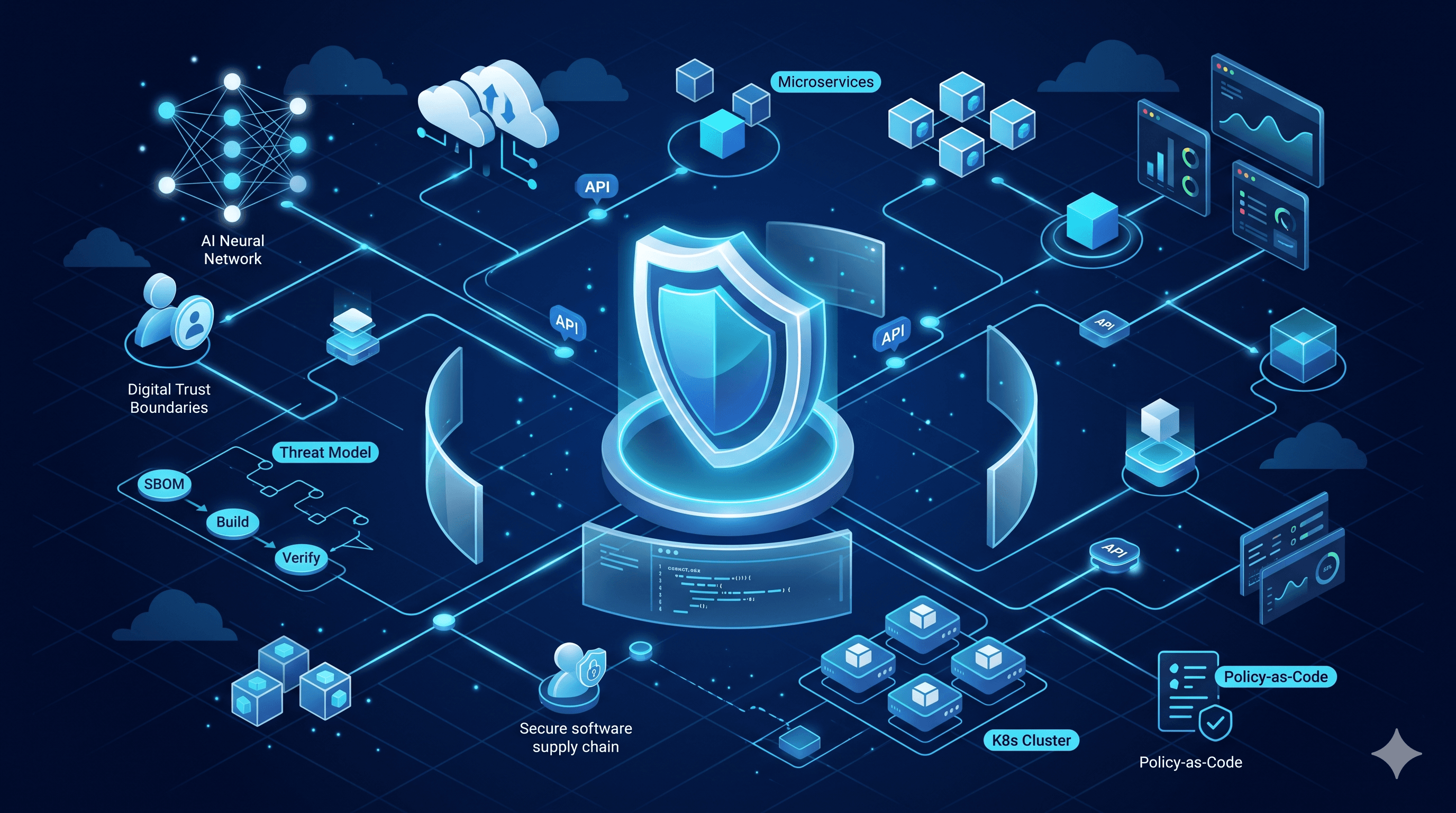
Generated by Gemini
Security is not a feature you bolt on at the end. It is an architectural property you bake in from the beginning or you spend the rest of your organization's life paying the interest on the debt.
The Architecture Gap Is Now the Attack Surface
The dominant source of critical vulnerabilities has shifted. It moved away from classic implementation bugs buffer overflows, SQL injections toward something harder to catch in a code review: architectural decisions made too early, without adequate threat context.
The 2024 Verizon DBIR found that over 68% of breaches involved the human element, but beneath that headline lies a more structural story: misconfigured cloud environments, over-permissioned service accounts, implicit trust between microservices, unchecked third-party components. These are not coding mistakes. They are design failures.
Four forces are amplifying this in 2026:
- AI-Generated Code — AI assistants accelerate output by 30–50%, but they also propagate insecure patterns at scale before anyone catches them.
- Cloud-Native Complexity — Hundreds of microservices communicating over APIs and event buses create trust boundaries that are implicit, unchecked, or undocumented.
- Software Supply Chain Exposure — Incidents involving GitHub Actions workflow poisoning, the Shai-Hulud self-propagating malware, and targeted compromises of upstream OAuth tokens and AI pipelines prove your attack surface includes every dependency, build tool, and CI/CD pipeline in your ecosystem.
- Agentic AI Systems — AI agents with tool access, memory, and autonomy represent a new class of principal in your architecture, one the industry has not yet secured. The answer is not more scanning or more patching. It is better principles of secure design, applied deliberately and early.
Why Secure Design Matters
In 2021, OWASP introduced A04: Insecure Design as a standalone Top 10 category, an acknowledgment that the industry spent twenty years hardening implementations while leaving architectural blueprints largely unchallenged.
The economics are stark. IBM's Cost of a Data Breach Report shows vulnerabilities fixed at design cost 6x less than those caught during testing and 15x less than those discovered in production. When you redesign a distributed authorization model after a breach, you are not fixing a bug, you are re-architecting trust relationships across dozens of services under regulatory scrutiny.
Regulators have caught up. CISA's Secure by Design initiative places explicit responsibility on software manufacturers to eliminate vulnerability classes through design. NIST's SSDF (SP 800-218) requires security requirements before architecture is finalized. The EU Cyber Resilience Act mandates security-by-design for connected products. Compliance is now a design constraint, not a lagging audit.
Security debt created at design time is the most expensive debt in the technical estate. Every architectural shortcut compounds into a liability paid either during a design review — or during an incident response.
Core Principles of Secure Design
These are active design decisions every architecture review must verify, grounded in cloud-native reality, not legacy datacenter assumptions.
Least Privilege
Every principal, user, service, or AI agent operates with the minimum permissions required, nothing more. In practice, decompose IAM to the verb-noun level (
s3:GetObject on a specific ARN, not s3:* on *). Use workload identity (AWS IRSA, GCP Workload Identity) to eliminate static credentials. For AI agents, define an explicit tool permission manifest and enforce it at the orchestration layer, never trust the model to self-limit.Defense in Depth
Layer independent controls so no single failure causes a full breach. In microservices, this means mTLS between services, per-request authorization at the application layer, runtime anomaly detection, and immutable infrastructure, all working independently. Critical mistake: treating TLS as a security control. TLS encrypts the transport; it does not authenticate the caller or authorize the request.
Separation of Duties
No single principal completes a sensitive operation alone. In CI/CD, the engineer who writes code should not also approve, merge, and deploy it, SolarWinds demonstrated the catastrophic result at scale. Enforce branch protection with required reviewers, separate signing keys from deployment keys, and use ephemeral per-pipeline credentials scoped to each stage.
Fail Securely
Under failure, default to the most restrictive safe state. If your authorization service is unavailable, your API gateway returns 403, not 200. Test this explicitly with chaos engineering. Critical mistake: circuit breakers configured to fail open for availability, creating security bypasses during outages.
Secure Defaults
Ship the most secure configuration, not the most convenient one. Encode secure defaults into IaC templates (Terraform modules, Helm charts) so every deployment inherits them automatically. S3 now defaults to private, extend this posture to your application layer: SameSite=Strict cookies, HSTS preloading, debug endpoints disabled, verbose errors suppressed.
Minimize Attack Surface
Every API endpoint, open port, dependency, and service account is attack surface. Maintain an API inventory through your gateway. Enforce Kubernetes NetworkPolicies as default-deny. Sunset unused endpoints. Remove zero-usage dependencies. Use private cloud endpoints where public access is unnecessary.
Complete Mediation
Every access to every resource is checked on every request; no exceptions, no cached decisions that outlive their validity. Centralize authorization in a dedicated policy engine (Open Policy Agent, Cedar, AWS Verified Permissions). Short-lived tokens (15 minute expiry) bound the window of unauthorized access. Distributed authorization logic across services is fragmentation that attackers exploit.
Zero Trust by Default
Trust nothing. Verify everything. Authenticate and authorize every request on every hop regardless of network location. Implement SPIFFE/SPIRE for workload identity, mTLS for service-to-service authentication, and continuous device posture verification before granting resource access.
Zero Trust is not a product; it is an architecture. The control plane is identity. Every service, device, and agent must prove who it is on every request, and authorization must be evaluated per-request, not per-session.
Assume Breach
Design as if an attacker is already inside. Invest in detection, containment, and recovery; not just prevention. Define blast radius boundaries explicitly (separate AWS accounts per trust level). Deploy honeytokens to detect breach conditions earlier. Conduct purple team exercises that simulate lateral movement within your actual architecture.
Security Observability & Resilience
Generate structured telemetry — logs, metrics, traces, security events — correlated in near real time. Immutable audit trails in WORM-compliant storage are non-negotiable. Design blast radius boundaries so one compromised service cannot cascade. Test backup and recovery procedures quarterly, including secrets and certificate restoration.
Secure Design for AI Systems
LLM-based applications and agentic frameworks introduce a new attack surface that existing principles must be explicitly adapted to address.
Prompt Injection is the AI equivalent of SQL injection, where untrusted content in the model's input manipulates its behavior. Treat all externally sourced content as untrusted data, never as instructions. Implement LLM firewall layers (LlamaGuard, Vigil) at ingress. Maintain strict separation between system prompts and user-supplied content.
Agent Permissions are the least-privilege problem at the AI layer. An LLM orchestrator that can call any registered tool without per-call authorization is a privilege escalation vector. Require human confirmation for irreversible actions (deletions, financial transactions, external communications). Log every tool call with the full context that triggered it.
Secure RAG Architectures must enforce document-level access control at retrieval time, not just ingestion. A user querying a RAG system should only retrieve documents they are authorized to access. Sensitivity labels must be enforced before documents enter the model context.
Threat Modeling, Secure Lifecycle & Checklist
Threat modeling is a design activity, not an audit. STRIDE (Spoofing, Tampering, Repudiation, Information Disclosure, Denial of Service, Elevation of Privilege) applied to each data flow in a system diagram surfaces control gaps that no code review will catch. In Agile, a 90-minute STRIDE session at the start of each feature epic beats a comprehensive annual review.
The secure development lifecycle operationalizes these principles: security requirements mapped to OWASP ASVS at the requirements phase; trust boundary review before architecture sign-off; mandatory SAST, SCA, IaC linting, and secrets scanning as CI/CD gates; SBOM generation (CycloneDX/SPDX) and Sigstore artifact signing on every build.
Practical Design Review Checklist
| Question | Risk | Recommended Control |
|---|---|---|
| Are trust boundaries explicitly documented? | Lateral movement via implicit trust | Mandatory trust boundary diagrams before architecture approval |
| Are all APIs authenticated with a standard protocol? | Unauthorized API access | OAuth 2.0/OIDC enforced at API gateway |
| Is authorization centralized in a policy engine? | Fragmented logic, BOLA vulnerabilities | OPA or Cedar as centralized PDP |
| Are secrets in a dedicated secrets manager? | Credential exposure via env vars or config | Vault, AWS Secrets Manager; zero static credentials |
| Are audit logs immutable? | Log tampering post-breach | WORM-compliant storage with integrity monitoring |
| Is tenant isolation validated end-to-end? | Cross-tenant data leakage | Automated isolation tests in CI/CD |
| Have AI agent tool permissions been scoped? | Over-permissioned agent actions | Capability manifests enforced at orchestration layer |
| Does the system fail securely? | Fail-open during outage | Chaos engineering tests for fail-closed behavior |
Five Questions Every Security Architect Must Ask
- "What happens when this fails?" If you cannot describe system behavior under failure, the design is incomplete. Every failure mode must default to a secure state.
- "Who are the principals, and what are they allowed to do?" Name every human, service, device, and AI agent. If a principal's permission set cannot be described in one sentence, it is too broad.
- "Where are the trust boundaries, and how are they enforced?" Trust enforced by convention or documentation is not enforced. It must be code.
- "What data is this system handling, and where does it go?" Sensitive data must be tracked from ingestion to deletion. If you cannot produce a data flow diagram, the design is not ready for review.
- "How will we detect a breach in the first 30 minutes?" Security design without a detection and response strategy is incomplete. Define the telemetry and the first three response steps before you ship.
Future Trends: 2026 and Beyond
- Continuous Trust Evaluation — Static authorization decisions are giving way to real-time trust scores based on device posture, behavioral signals, and contextual risk. Mid-session privilege revocation is becoming standard in mature Zero Trust implementations.
- Post-Quantum Readiness — NIST finalized ML-KEM and ML-DSA standards in 2024. "Harvest now, decrypt later" attacks make migration planning an immediate priority, not a future concern.
- Policy-as-Code — Security guardrails expressed in OPA/Rego, Cedar, or CloudFormation Guard enable version-controlled, CI/CD-integrated, automatically tested security policy.
- Supply Chain Attestation — SLSA Level 3 provenance attestation is becoming a procurement requirement. Cryptographically signed build provenance from source commit to deployed artifact is the next SBOM.
- Agentic DevSecOps — AI agents performing automated threat modeling, vulnerability remediation suggestion, and policy validation will compress the security feedback loop from days to minutes.
Conclusion: Security Is an Engineering Property
The security industry spent two decades telling developers to write better code. The vulnerability category shifted faster than the fix. The shift needed now is different in kind: security must be an engineering property defined at design time, not a layer applied afterward.
Security cannot be patched into architecture after the fact. An authorization model designed for a monolith cannot be retrofitted onto microservices without a complete redesign. Build secure systems deliberately or spend the rest of your engineering career patching the ones you didn't.
The organizations winning on security in 2026 treat every architecture review as a security conversation, every design document as a threat model input, and every engineering decision as a security decision. That is the only posture that scales.
References
- OWASP. Top 10 2021: A04 Insecure Design. https://owasp.org/Top10/A04_2021-Insecure_Design/
- OWASP. API Security Top 10 2023. https://owasp.org/API-Security/
- OWASP. Application Security Verification Standard (ASVS) v4.0. https://owasp.org/www-project-application-security-verification-standard/
- CISA. Secure by Design. https://www.cisa.gov/resources-tools/resources/secure-by-design
- NIST. SSDF SP 800-218. https://csrc.nist.gov/publications/detail/sp/800-218/final
- NIST. Zero Trust Architecture SP 800-207. https://csrc.nist.gov/publications/detail/sp/800-207/final
- CISA. Zero Trust Maturity Model v2.0. https://www.cisa.gov/zero-trust-maturity-model
- IBM Security. Cost of a Data Breach Report 2024. https://www.ibm.com/reports/data-breach
- Verizon. 2024 Data Breach Investigations Report. https://www.verizon.com/business/resources/reports/dbir/
- OpenSSF. SLSA Supply Chain Levels for Software Artifacts. https://slsa.dev
- NIST. Post-Quantum Cryptography Standardization. https://csrc.nist.gov/projects/post-quantum-cryptography
- CNCF. SPIFFE — Secure Production Identity Framework for Everyone. https://spiffe.io