Back to Blog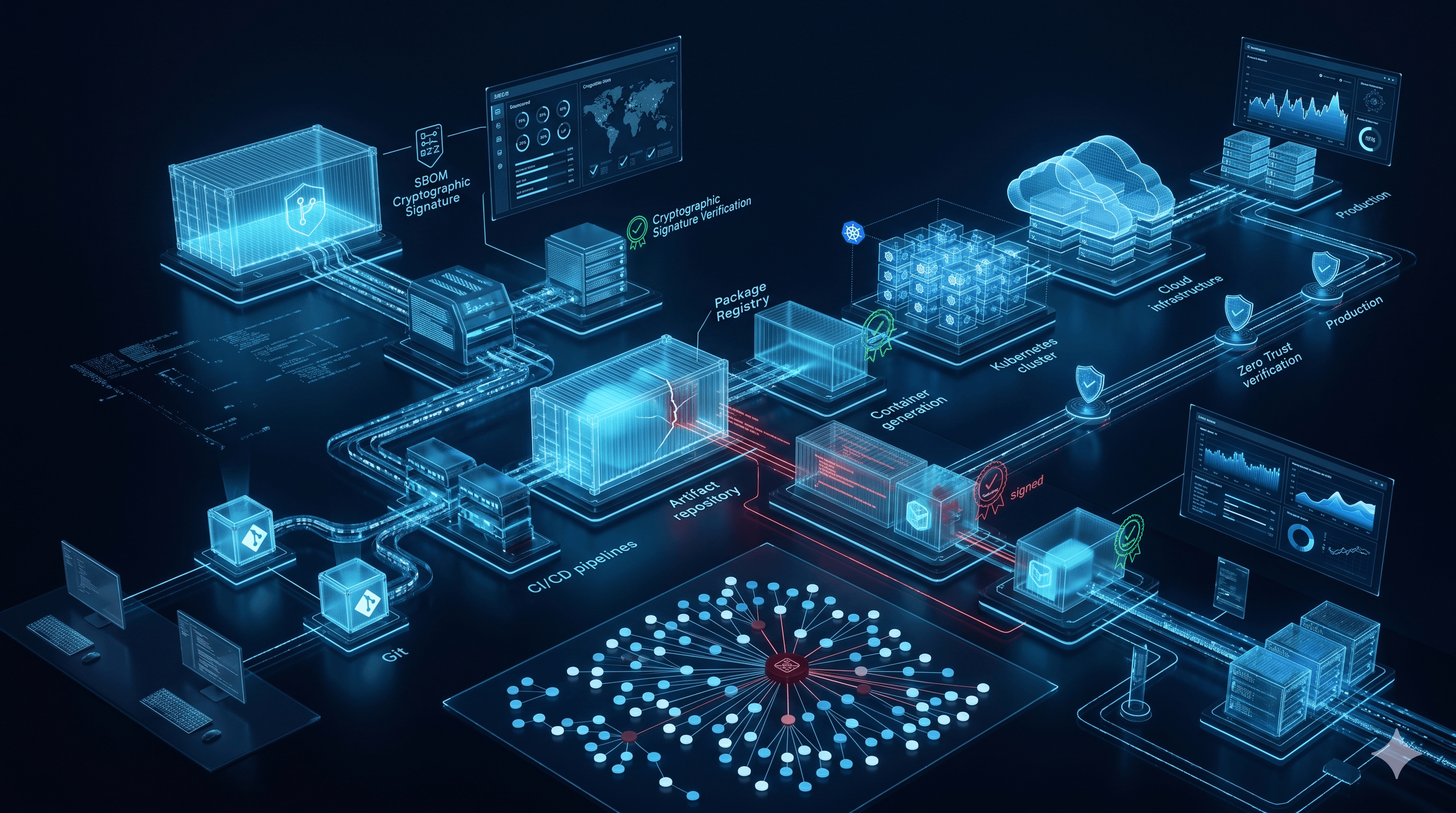
Cyber Security
June 14, 2026
Rohan Takke
10 min read
Software Supply Chain Security in 2026: When Trust Became the Attack Surface
How 2026's defining supply chain attacks (the Shai-Hulud worm, the Axios compromise that reached OpenAI's signing keys, and the GitHub breach that started in a VS Code extension) actually worked, and the handful of controls that reduce real risk.
Generated by Gemini
When Trust Became the Attack Surface
Every few weeks this year, a familiar headline lands. A package you've never heard of poisoned thousands of builds. A worm tore through npm overnight. A security vendor got breached through its own GitHub.
Most coverage stops at the logo and the scary number.
But the logo is never the lesson.
The lesson is always the same uncomfortable mechanic: attackers stopped breaking into production and started getting shipped into it. They moved one step to the left into the laptop, the registry, the CI runner, the model hub; because that's where the trust lives and the controls don't.
Why This Keeps Happening
Your code is mostly other people's code: Black Duck's OSSRA report has shown for years that most codebases are open source by line count. Compromise one popular library and you don't get one victim, you get everyone downstream. The math favors the attacker.
The registries are open on purpose: npm, PyPI, Docker Hub, and Hugging Face win because anyone can publish in seconds with no gatekeeper. So a typosquat or a malicious model can be live and installable before a human ever looks at it.
We got good at defending the wrong place: Fifteen years of EDR, WAFs, and segmentation made the runtime expensive to attack. So attackers left. Ship your code inside the victim's trusted build and you inherit every privilege first-party software gets signed, allow-listed, running with production secrets.
Why pick the lock when you can be handed the keys?
The Techniques Aren't New. The Scale Is.
None of this started in 2026. The playbook was written earlier.
xz-utils (2024) showed patience as a weapon: An attacker spent two years earning a volunteer maintainer's trust, then hid a backdoor in the build process, invisible to source review. Dependency confusion (PyTorch's torchtriton) showed that an internal package name, if it also exists on a public registry, can be silently shadowed. Typosquatting (
crossenv, python3-dateutil) and brandjacking (the polyfill.io CDN, sold and weaponized) showed that a single character or an expired domain is enough.What changed in 2026 is velocity and reach. The same moves now self-replicate, target AI tooling, and land inside the most security-mature companies on earth.
2026 in Three Attacks
You can understand the whole year through three incidents.
1. The worm woke up: Shai-Hulud
For years, supply chain attacks were one-offs. A package compromised, detected, cleaned up.
2026 changed the physics. Malware learned to self-replicate.
The Shai-Hulud family (and its variants Mini Shai-Hulud, Miasma, and Hades) steals developer and CI/CD credentials at install time, then uses the stolen publishing tokens to inject itself into more packages which compromise more developers, which publish to more packages.
By June 2026, Socket was tracking a single connected campaign across 448 artifacts on npm and PyPI, after hitting the
@antv ecosystem (639 versions), TanStack, and Red Hat Cloud Services packages. npm's response says it all: it invalidated every access token capable of bypassing 2FA after one wave compromised 323 packages.The clever part is how it runs before anyone reviews the code — npm
postinstall hooks, or on PyPI a *-setup.pth file that Python executes at every interpreter startup, so the next pip or pytest run fires the payload without you ever importing the package. It even hunts for Claude/MCP configs and Anthropic API tokens alongside cloud and registry secrets.The worm isn't a metaphor anymore. It's the operating model.
2. One phished maintainer, 100 million downloads: Axios
axios is one of the most-used HTTP clients in JavaScript with ~100M weekly downloads.In March 2026, two malicious versions were published directly to npm from a hijacked maintainer account (no matching GitHub tag — the tell). The change was tiny: it added one freshly published typosquat dependency that carried a self-deleting remote access trojan.
How did the attacker get publish rights? Not by breaking npm — by breaking a human. A DPRK-nexus crew (Mandiant's UNC1069) ran a fake-recruiter campaign: weeks of rapport on LinkedIn/Slack, a video call on a spoofed Teams page, a fake "audio failed" prompt to install a "fix" that was the RAT. The same campaign targeted the maintainers of Lodash, Fastify, and dotenv.
The line every leader should memorize:
Once a RAT is on your machine, it steals your post-authentication state. 2FA becomes irrelevant. OIDC "trusted publishing" doesn't save you either.
Then the downstream act: that malicious
axios ran inside OpenAI's macOS app-signing workflow, forcing a certificate rotation. OpenAI's own root cause? The workflow used a floating tag instead of a commit hash, and had no minimum release age.Two settings stood between an attacker and malware signed as OpenAI.
3. The breach that didn't start at GitHub
When GitHub's internal environment was breached in May 2026, everyone assumed a zero-day in GitHub's infrastructure.
That assumption was wrong.
The attack (attributed to TeamPCP / UNC6780) started in a developer's IDE. A poisoned Nx Console VS Code extension (
nrwl.angular-console 18.95.0) — published via a stolen contributor token and a hidden orphan commit was live for just 11–18 minutes. Long enough. It dropped a Python backdoor (cat.py) on a GitHub employee's workstation.From that one machine, ~3,800 internal repositories were cloned and exfiltrated, later advertised on a forum for ~$50,000. The malware even used the GitHub Search API itself as command-and-control, blending into normal developer traffic. Weeks earlier, Wiz had disclosed CVE-2026-3854, an RCE in GitHub's internal Git push-option handling.
The GitHub breach wasn't advanced malware. It was one developer, one extension, one update. That's exactly what makes it dangerous.
It wasn't alone. The "Megalodon" campaign wormed through 5,500+ GitHub repos via malicious "automated" commits, and Grafana and Trellix had repos breached in the same wave.
The Pattern: Signed ≠ Safe
Notice what every one of these shares.
The malicious code was correctly signed, passed scanners, and would appear in an SBOM as a normal entry.
- An SBOM is an inventory, not an integrity check — xz-utils would look like a trusted line item.
- Code signing proves who produced an artifact, not that it's good. Compromise the build or the identity, and the malware is signed (Ultralytics, xz, Axios).
- CVE scanners match known-vulnerable versions. A born-malicious or freshly hijacked package has no CVE and in 2026 NIST stopped enriching most CVEs anyway.
The single most important mental update of the year:
Signed, scanned, and in the SBOM have all stopped meaning safe.
Rendering diagram...
The red nodes: Developer identities, registries, CI runners, and AI components all sit above the signing step. Anything injected there comes out signed and trusted. That's the whole strategy.
What Actually Reduces Risk
No single product fixes this. But a handful of controls kill most of 2026's attacks and almost all of them come down to one idea: stop trusting moving targets, and verify before you run.
| Audience | Single highest-leverage move |
|---|---|
| Developers | Hash-pinned lockfiles + passkeys on registry/source accounts |
| Security engineers | Enforced signature/provenance gates + operationalized SBOMs |
| DevOps | SHA-pin Actions, ephemeral runners, egress allow-lists, minimum release age |
| Product security | A secure-by-default golden CI template + inventory of models, MCP servers, and IDE extensions |
| CISO | Treat CI/CD as Tier-0; measure % of artifacts with verified provenance |
The two snippets that prevent the most damage:
# Pin Actions to a commit SHA, default tokens to read-only
permissions:
  contents: read
steps:
  - uses: actions/checkout@b4ffde65f46336ab88eb53be808477a3936bae11  # v4.1.1
# Install only from the lockfile; block install scripts by default
npm ci
npm config set ignore-scripts true
# pip: install only hash-verified packages
pip install --require-hashes -r requirements.txt
If you do nothing else: pin dependencies, Actions, and base images; turn on passkeys for registry and source accounts; and impose a minimum release age so you never auto-adopt a version published minutes ago. That alone neutralizes tj-actions, polyfill.io, Axios→OpenAI, and most maintainer hijacks.
Two newer surfaces deserve a place on the list. IDE extensions behave like dependencies but rarely get the same scrutiny the GitHub breach proved a single poisoned extension can reach internal repos, so track installation sources and enforce allow-lists. And AI components models, datasets, MCP servers are now in the worm's crosshairs: prefer safetensors over pickle, load untrusted models in a sandbox, and treat MCP and AI-tool tokens like any other secret, with least privilege and rotation.
The verification layer matters as much as the pinning. Sign artifacts with Sigstore (
cosign), attach SLSA provenance, and enforce it at deploy time with an admission controller so an unsigned or unexpected artifact is rejected, not merely logged. Attestations you generate but never check are theatre.FAQ
Will my vulnerability scanner catch a malicious package? Usually not. Scanners match known vulnerabilities. A hijacked or born-malicious package has no CVE. You need behavioral analysis of install scripts, reputation signals, and provenance checks.
Doesn't code signing prove software is safe? It proves who, not good. The dominant 2026 pattern yields correctly signed malware. Verify the signing identity and provenance, not just that a signature exists.
What's the most impactful change for a small team? Pin everything (lockfile hashes, SHA-pinned Actions, digest-pinned images) and turn on hardware MFA. Near-zero cost, kills the largest class of attacks.
If I'm hit by Shai-Hulud, what do I do? Remove/pin away from the bad version, rebuild affected environments, and rotate every credential the machine or CI job could reach — GitHub, package-publishing, cloud, SSH, and AI-tool tokens (including Anthropic/MCP). Then hunt for unexpected public repos and anomalous workflow runs.
The Bigger Picture
The center of gravity in software security moved left of production. It isn't moving back.
Attackers go where trust is granted but rarely verified: developer identities, registries, CI runners, model hubs, and source repos.
The teams that get compromised in 2026 won't mostly be the ones who lacked a tool. They'll be the ones who produced attestations and never enforced them, who scanned for CVEs and never watched for tampering, and who locked the front door while leaving the road that builds the house wide open.
The question is no longer whether a supply chain attack will reach you.
It's how far it'll propagate when it does.
References
- Socket — Shai-Hulud / Hades PyPI wave (Jun 2026): https://socket.dev/blog/shai-hulud-descends-to-hades-miasma-pypi-wave
- Socket — npm invalidates 2FA-bypassing tokens (May 2026): https://socket.dev/blog/npm-invalidates-tokens-mini-shai-hulud
- Socket — Axios npm compromise (Mar 2026): https://socket.dev/blog/axios-npm-package-compromised
- Socket — Axios → OpenAI signing pipeline (Apr 2026): https://socket.dev/blog/axios-supply-chain-attack-reaches-openai-macos-signing-pipeline-forces-certificate-rotation
- OpenAI — Axios developer tool compromise disclosure: https://openai.com/index/axios-developer-tool-compromise/
- Mandiant — UNC1069 social-engineering campaign: https://cloud.google.com/blog/topics/threat-intelligence/unc1069-targets-cryptocurrency-ai-social-engineering
- Rohan Takke — Decoding the GitHub 2026 Breach (Nx Console, CVE-2026-3854): https://www.rohantakke.in/blog/github-breach-2026
- Cyber Management Alliance — biggest supply chain attacks of 2026: https://www.cm-alliance.com/cybersecurity-blog/5-of-the-biggest-supply-chain-attacks-of-2026-so-far
- CISA — SBOM: https://www.cisa.gov/sbom
- SLSA: https://slsa.dev/spec/v1.0/levels
- Sigstore (Cosign / Fulcio / Rekor): https://www.sigstore.dev/
- OpenSSF Scorecard: https://securityscorecards.dev/
- NIST SSDF (SP 800-218): https://csrc.nist.gov/pubs/sp/800/218/final
- Socket — NIST stops enriching most CVEs (Apr 2026): https://socket.dev/blog/nist-officially-stops-enriching-most-cves