Back to Blog
Security Architecture
May 16, 2026
Rohan Takke
7 min read
Threat Modeling: The Missing Layer in Modern Product Security
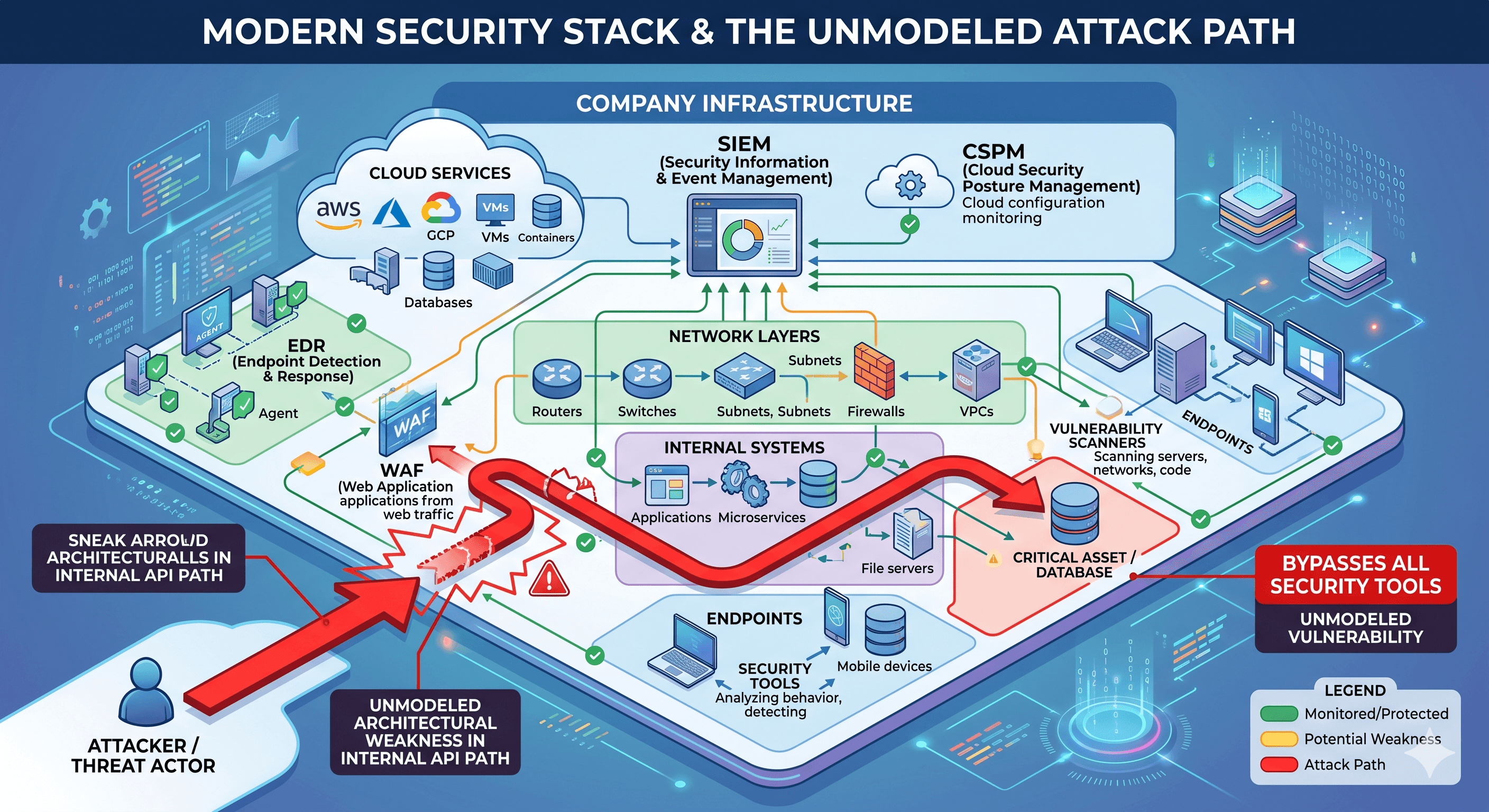
Your company has an EDR, a SIEM, a CSPM — and you're still getting breached through architecture.
Your company has an EDR. A SIEM. A CSPM. Probably a WAF, a vulnerability scanner, maybe even an AI-powered anomaly detection platform.
Your Jira board has hundreds of unresolved security findings. Your dashboards look healthy. Your patching metrics look impressive.
Then someone finds a misconfigured internal API endpoint, pivots through an over-permissioned service account, and compromises sensitive customer data in under an hour.
That’s the uncomfortable reality modern security teams are facing.
Many organizations have invested heavily in:
- EDR
- SIEM
- CSPM
- vulnerability scanners
- cloud security tooling
- AI-based detection platforms
…but still struggle with architectural security weaknesses.
The problem is not the lack of tooling.
The problem is that very few teams spend enough time asking:
"How can this system actually be attacked?"
That discipline is called Threat Modeling.
And it remains one of the most underrated areas in modern product security.
Generated by Gemini
What Threat Modeling Actually Is
Threat modeling is not just creating diagrams or filling compliance documents.
In practice, threat modeling means:
Looking at your architecture from an attacker's perspective and identifying where trust can fail.
It involves understanding:
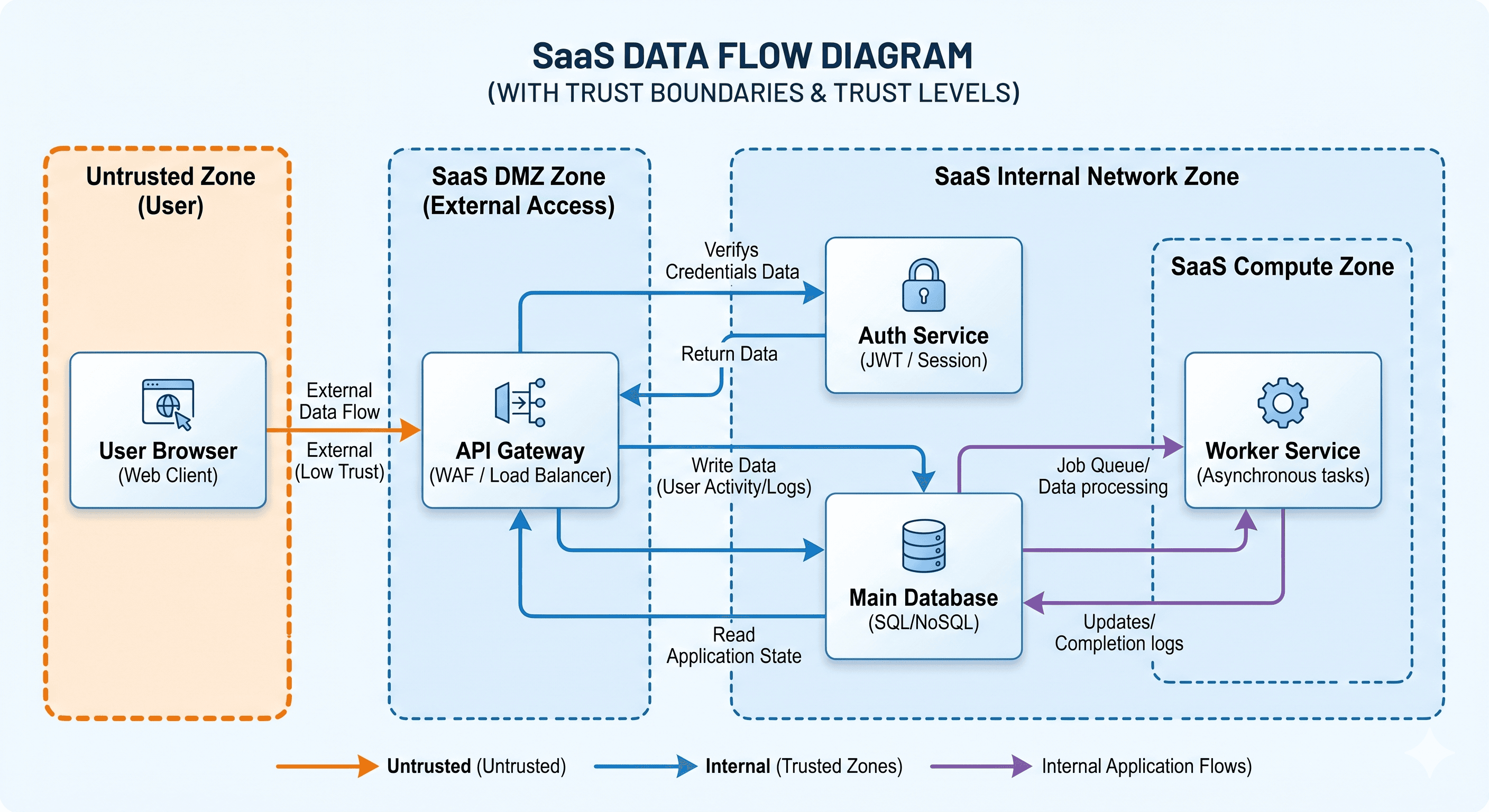
- data flows
- trust boundaries
- authentication paths
- authorization logic
- service-to-service communication
- attacker entry points
- lateral movement opportunities
The goal is simple:
Find dangerous assumptions before attackers do.
Core Concept
Threat modeling usually revolves around four questions:
- What are we building?
- What can go wrong?
- What are we doing about it?
- Did we do a good enough job?
Most teams stop at question #2.
Generated by Gemini
Why Threat Modeling Gets Ignored
1. Startup Velocity
Fast-moving startups optimize for shipping quickly.
Security becomes:
- "Is MFA enabled?"
- "Are S3 buckets private?"
- "Did the scan pass?"
Very few teams pause to analyze the architecture deeply.
Unfortunately, this mindset often survives even after the company scales.
2. Compliance-Driven Security
Many organizations mistake compliance for security maturity.
They have:
- policies
- audit reports
- risk registers
- spreadsheets
- certifications
But nobody has actually mapped realistic attack paths.
The Real Problem
Compliance proves you documented security.Threat modeling proves you actually understand your risks.
3. Over-Reliance on Scanners
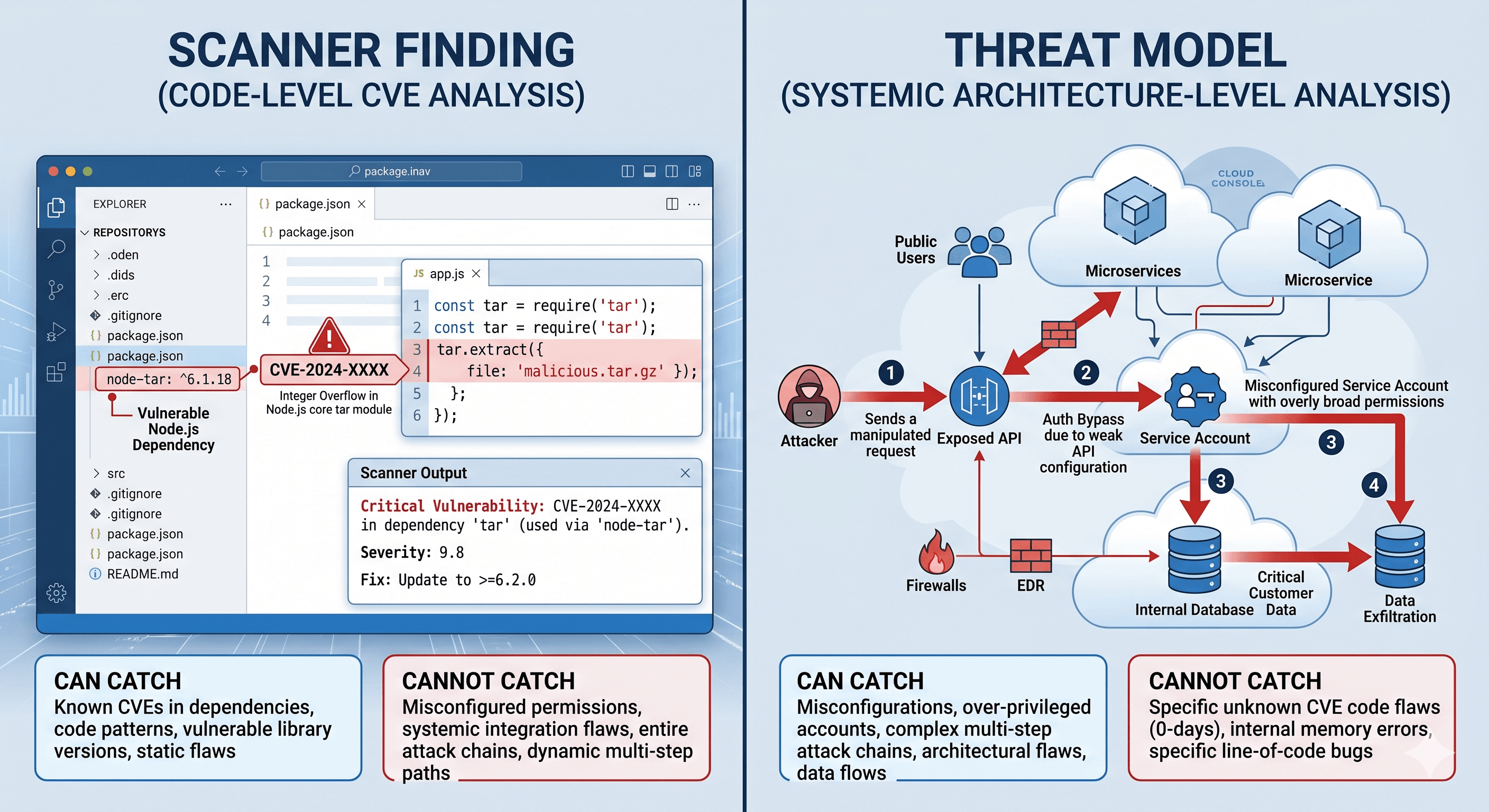
Modern scanners are extremely useful.
But scanners mainly identify:
- known CVEs
- dependency issues
- configuration weaknesses
- exposed services
- vulnerable libraries
They do not understand:
- broken trust assumptions
- insecure architecture decisions
- flawed authorization models
- attacker movement paths
That requires human analysis.
4. Engineers Think It's Documentation Overhead
Bad threat modeling becomes useless documentation.
Good threat modeling produces:
- better architecture decisions
- engineering discussions
- backlog improvements
- design changes
- stronger trust boundaries
If the output changes nothing technically, the exercise failed.
The Complexity Problem
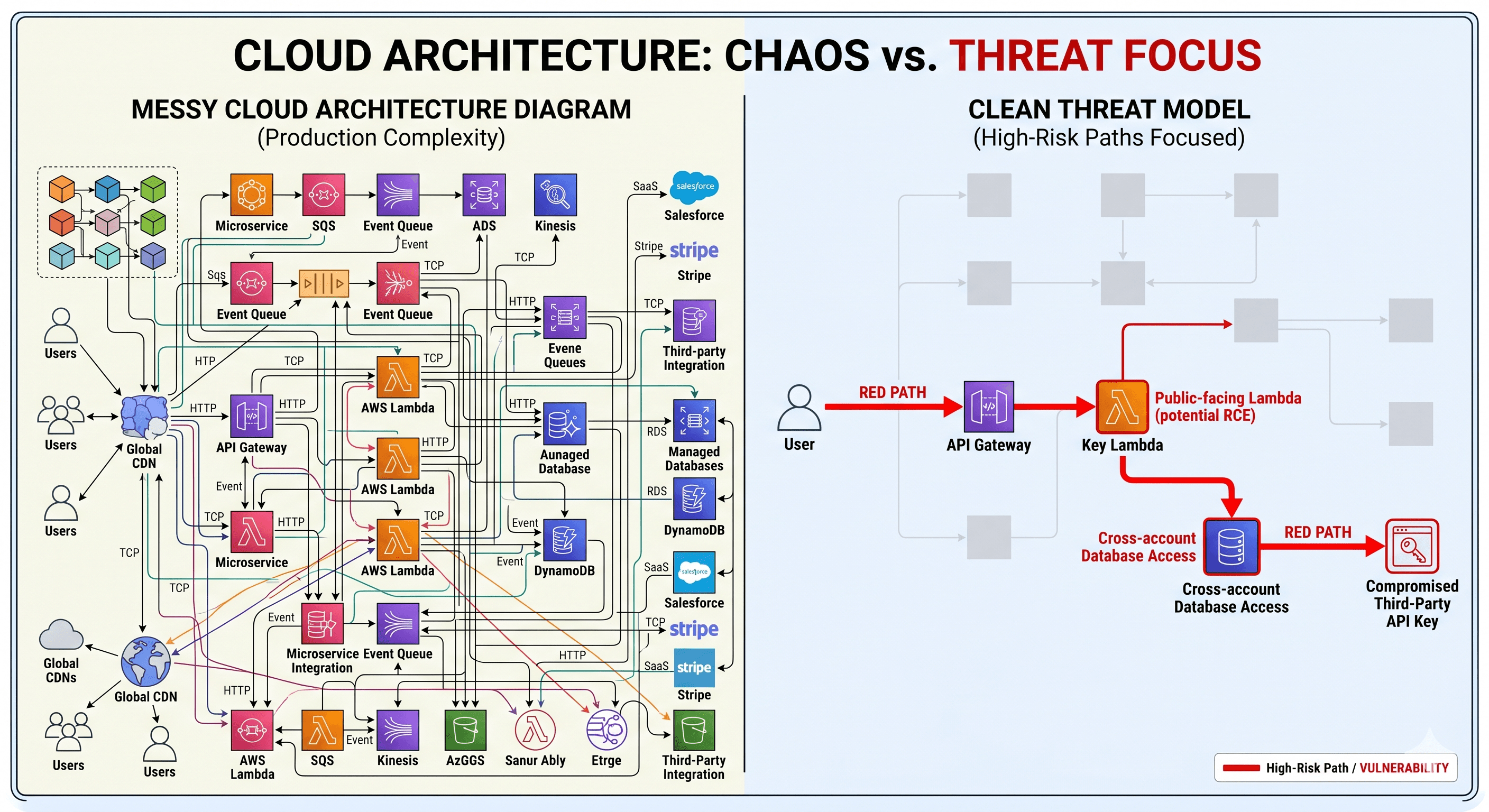
Modern cloud architectures are genuinely hard to model. Ten microservices. Event queues. Lambda functions. Managed services with their own IAM models. Third-party SaaS integrations. Multi-region deployments. If you're waiting to have a perfect architecture diagram before you start, you're never starting. The complexity of modern systems is a reason to do more threat modeling, not less but it scares teams off.
Generated by Gemini
The Real Problems Threat Modeling Prevents
Exposed Internal APIs
An internal API intended for private access accidentally becomes reachable because:
- firewall rules drifted
- ingress policies changed
- Kubernetes configuration was modified
- temporary debugging access remained enabled
No vulnerability scanner understands the original trust assumption.
Threat modeling does.
Weak IAM Policies
One of the most common cloud security issues.
Examples include:
- wildcard IAM permissions
- excessive admin privileges
- unused service accounts
- over-permissioned CI/CD pipelines
If one service gets compromised, attackers can laterally move across the environment.
Threat modeling helps identify blast radius early.
Broken Service-to-Service Trust
Internal services often trust each other too much.
Common assumptions:
- "It's internal traffic"
- "Only trusted services can call this"
- "The gateway already validated the request"
Attackers love these assumptions.
Once one service is compromised, weak trust boundaries make lateral movement much easier.
Broken Authorization Logic
A very common example:
An endpoint checks whether a user is authenticated — but forgets to verify whether they are authorized for the action.
Result:
- privilege escalation
- tenant data exposure
- IDOR vulnerabilities
- admin function abuse
These problems are often architectural, not just coding mistakes.
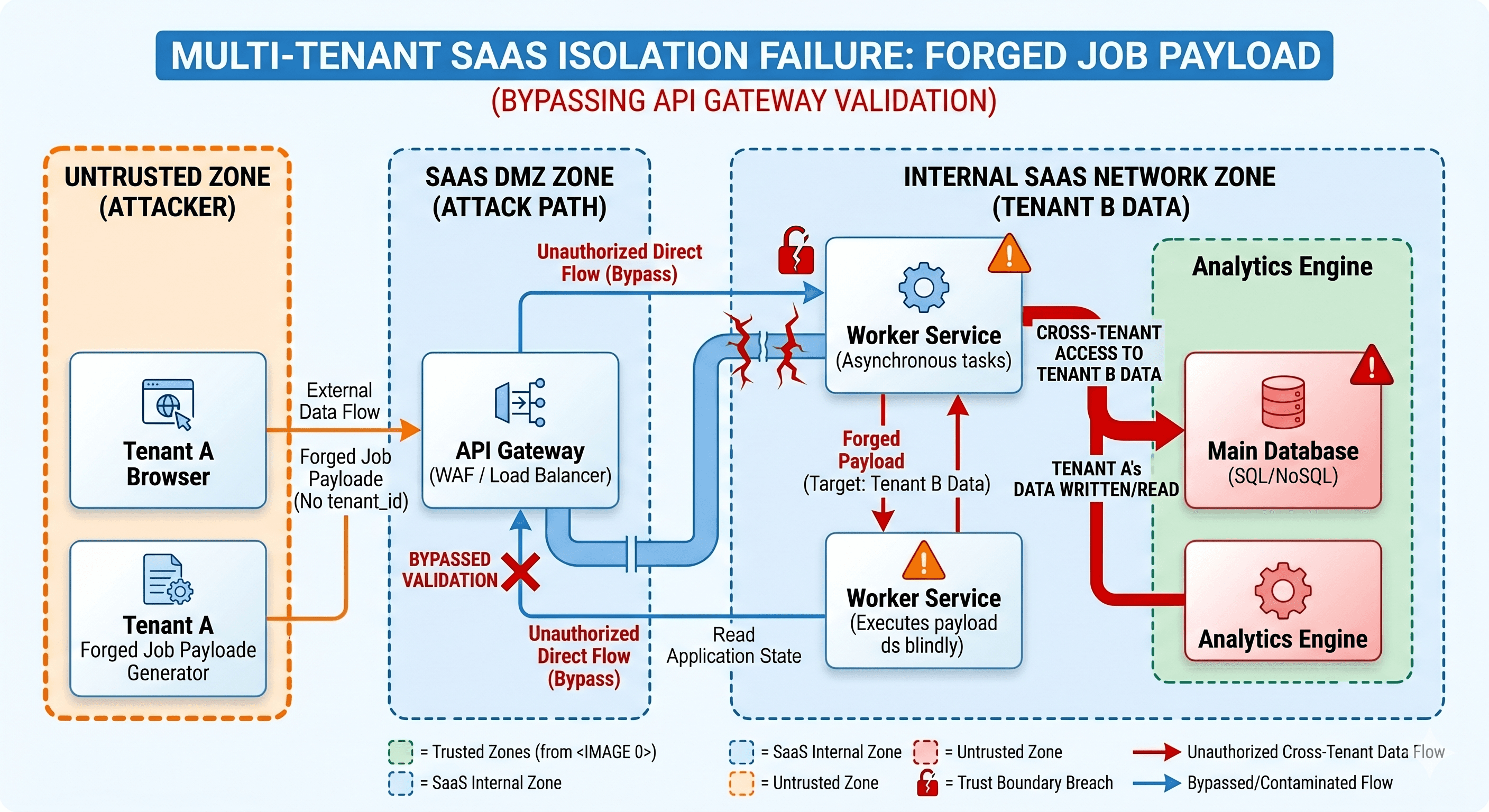
Multi-Tenant Isolation Failures
Critical for SaaS products.
A product may correctly validate tenant access in APIs but completely miss validation inside:
- background workers
- async queues
- exports
- reporting jobs
- internal processing pipelines
Threat modeling helps teams analyze every data flow — not just frontend API paths.
Generated by Gemini
Vulnerability Scanning vs Threat Modeling
Both are important.
But they solve different problems.
| Vulnerability Scanning | Threat Modeling |
|---|---|
| Finds known vulnerabilities | Finds architectural weaknesses |
| Mostly automated | Human-driven analysis |
| Focuses on code/configuration | Focuses on system design |
| Detects known patterns | Predicts attacker behavior |
| Continuous scanning | Design-phase analysis |
| Good for hygiene | Good for strategic security |
Simple Analogy
Vulnerability scanning checks whether your doors and windows are locked.Threat modeling asks whether you accidentally built the house with a secret tunnel underneath it.
Generated by Gemini
Example: Threat Modeling a SaaS Architecture
Imagine a SaaS platform with:
- Portal UI
- API Gateway
- Auth Service
- Redis
- MongoDB
- Worker Service
- S3 Storage
- Admin Panel
At first glance, everything looks secure.
But now ask:
- What happens if the Worker Service gets compromised?
- Can attackers forge tenant IDs?
- Does every service independently validate authorization?
- Can background jobs bypass API-level controls?
- What happens if VPN credentials for the Admin Panel leak?
These are threat modeling questions.
And many major breaches begin exactly this way.
How Teams Can Start Threat Modeling
Threat modeling does not need to become a heavyweight enterprise process.
Start small.
Practical Approach
- Review high-risk systems first
- Focus on authentication and authorization flows
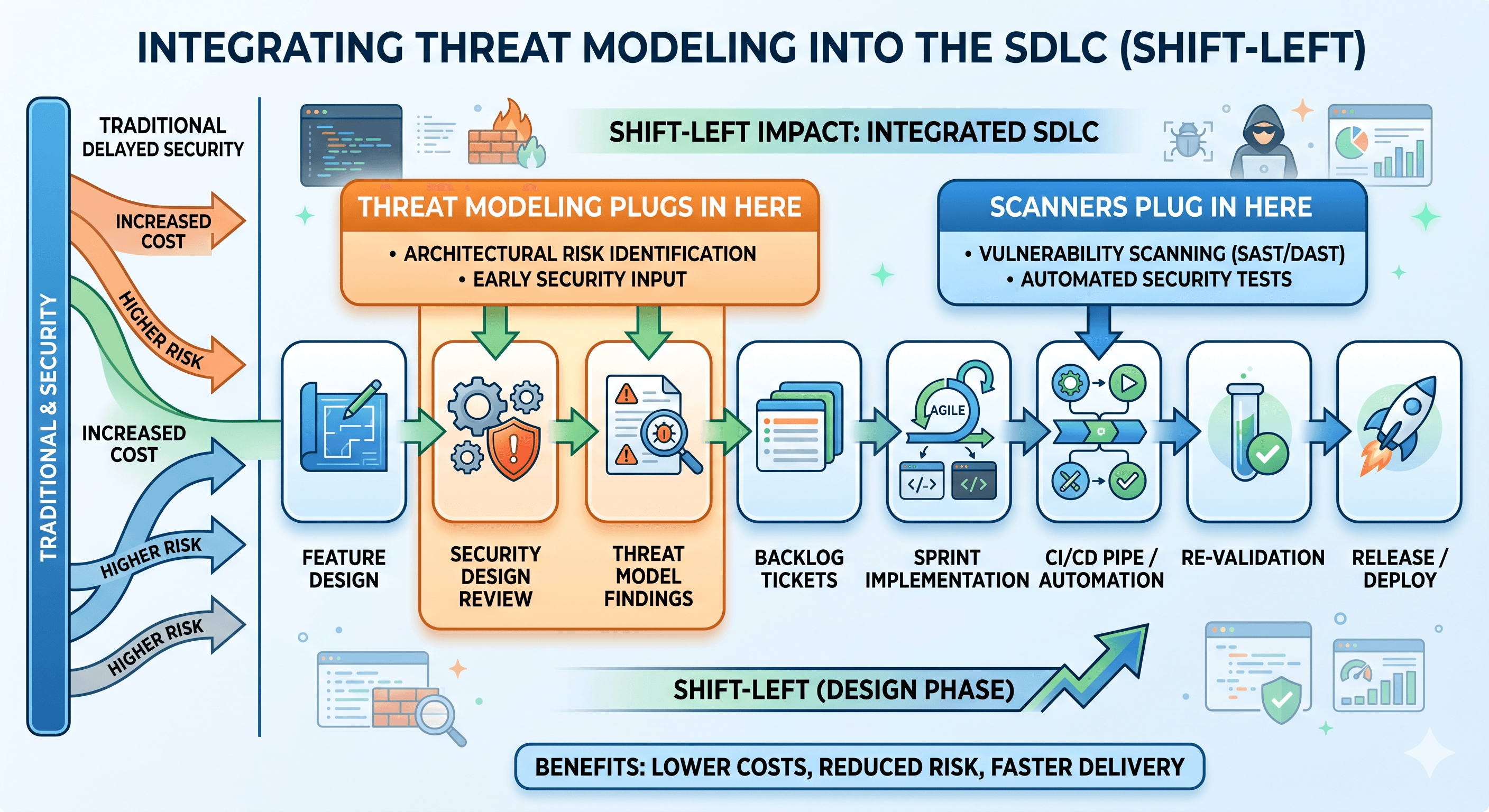
- Add lightweight security discussions during sprint planning
- Analyze trust boundaries during architecture reviews
- Create simple DFDs
- Track findings as engineering tasks
Useful Frameworks and Tools
You do not need complex tooling initially.
Simple whiteboard discussions are often enough.
Still, useful frameworks include:
- STRIDE
- MITRE ATT&CK
- DFDs
- OWASP Threat Dragon
- Microsoft Threat Modeling Tool
The methodology matters less than developing attacker-focused thinking.
Generated by Gemini
Final Thoughts
The security industry has become heavily tool-driven.
Tools are valuable.
But tools alone cannot understand:
- your architecture
- your trust assumptions
- your business logic
- your attacker paths
That requires human analysis.
It requires adversarial thinking.
And that is exactly why threat modeling matters.
Your attackers have already threat modeled your product.The real question is whether your team has.
Threat modeling is not just another security exercise.
It is a way of thinking.
And for modern product security teams, it may be one of the most valuable skills to build.